You are here: Events from 2013
The banking system between the restructuring of distressed assets and credit rebound
 Gordon W. JOHNSON (presentation)
 NPL Resolution - A Market Overview
Milo STEVANOVICH (presentation)
Risk Based Oversight Technology - Adapting technology for better governance
Cătălin PĂUNA (presentation)
Romania: prospects and challenges from a macroeconomic perspective
Marieta AVRAM (presentation)
Fraudulent practices in the insolvency procedure. Detection and prevention mechanisms
JW Marriott Bucharest Grand Hotel
Event's agenda (
 )
)The Romanian financial system is facing perhaps the greatest challenges in its history and is fighting to overcome them with minimal "collateral damages". What measures must be undertaken in order to strengthen it? Are there any obstacles to be removed? What are the costs of a structural reform?
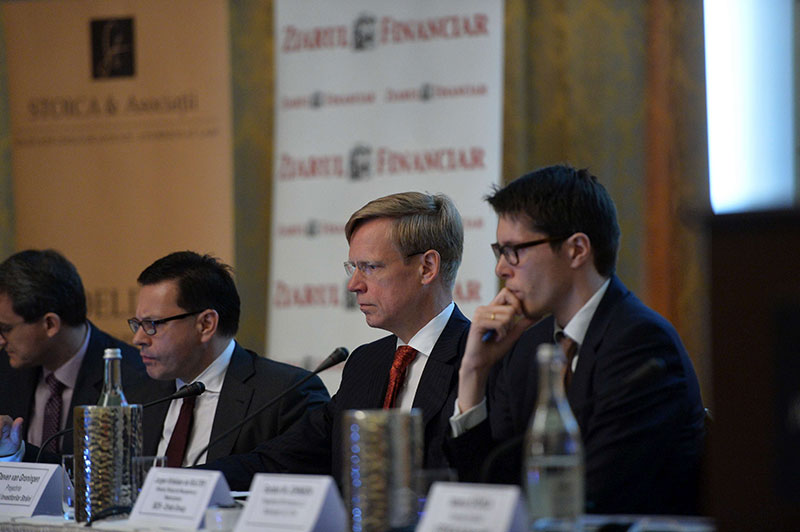
Turning to an audience of more than 150 participants from the banking & finance sector, notable speakers made an in-depth analysis of the Romanian banking system, of the critical situation of the NPL’s and of the measures that have to be undertaken in order to boost the credit and the national economy.
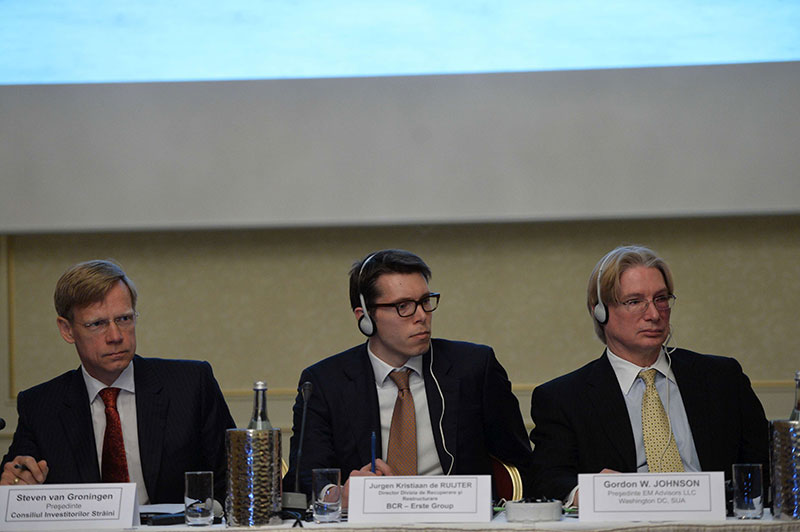
Gordon W. JOHNSON, President of EM Advisors LLC, Washington DC, US, Jurgen Kristiaan de RUIJTER, Head of Remedial & Recovery Division, BCR – Erste Group, Bucharest, Milo STEVANOVICH, IFC Program Manager for Middle East and North Africa, Cairo, Egypt, Steven van GRONINGEN, former President of the Foreign Investors Council, Romania, Marieta AVRAM, Senior Partner, STOICA & Asociaţii and Cătălin PĂUNA, Senior Economist, World Bank Office in Romania are the speakers invited to answer the questions posed by the event's moderators, Valeriu Stoica, Founding Partner, STOICA & Asociații together with Cristian Hoştiuc, Editorial Director, Ziarul Financiar.
From the perspective of the specialists having an extensive international experience, that included, among others, the advising of the Romanian Government at the end of the 1990’s in connection with the process of drafting and implementation of the legislative package with regards to some measures for accelerating the economic reform, Gordon W. JOHNSON and Milo STEVANOVICH touched upon the NPL’s situation on the European level and the technical solutions for mitigating the risks of fraud in connection with insolvency and restructuring proceedings.
 |
Gordon W. JOHNSON (biography) approached in his presentation the difficult situation of NPL’s management, analyzing from a statistical point of view the dynamics of the credits in Romania compared with other Central and South-Eastern Europe jurisdictions. Taking into account his vast expertise in the field of NPL’s restructuring, Gordon W. JOHNSON said that “the economy does not have growth resources without credit. In case the degree of NPL’s is high, credit slackens and the economy runs out of gas. It’s a descendent spiral and restructuring of the portfolios in order to move ahead is required.” |
 |
Milo STEVANOVICH (biography) showcased the modern technologies of fraud monitoring, specifically the detection and prevention mechanisms of fraud in insolvency and restructuring processes. Milo STEVANOVICH stated that in order to deter frauds, a change in legislation is required, but proper detecting mechanisms must also be in place. “There are fraud detection mechanisms because when you have a great data volume it is difficult to chase down the frauds without a model. I don’t believe there is a perfect system, but you have to deter frauds. The change of the legal framework is needed, in order to diminish the temptation of committing a fraud.” |
 |
Steven van GRONINGEN (biography) tackled in his presentation the problematic of private investment and of the short and medium term actions that have to be adopted in order to benefit from a sustainable economic growth. |
 |
Jurgen Kristiaan de RUIJTER (biography) approached in his presentation the practical problems with which the bank’s restructuring departments are confronting in the actual economic context, analyzing the situation of the restructuring from a legal, regulatory, fiscal and competition law perspective. |
 |
Marieta AVRAM (biography) tackled in her presentation some of the methods regarding creditors’ rights fraud mechanisms which are engaged in insolvency procedure by bad-faith debtors and, as well, the detection and prevention mechanisms available to the banks in accordance with the legislation in force. These illegal practices can be seen upon as resilient “viruses” that are hijacking the procedure from its main purpose, meaning the fulfillment of creditors’ debt and the increment of debtors’ patrimony. The Insolvency Code draft perceives these irregularities and proposes some solutions with the purpose of preventing and stopping them. |
 |
Cătălin PĂUNA (biography) presented the Romania’s macroeconomic situation, addresing, among other, some very actual and hot issues such as the driving force of the economic growth and the short and medium term perspectives of the rebound of the Romanian economy, inflation and currency exchange rate, the FDI’s and business environment situation and the critical need of structural reforms on all economy levels. |
The most important conclusion drawn from the conference’s debate is in connection with the fact that for the re-launching of banks’ credit activity and, in effect, for the inflow of “fresh blood” in the economy veins in order to boost it up, a unitary action plan of the public authorities with regard to the acceleration of the program of structural reforms for the reshaping of the national economy is highly necessary. The reluctance of the banks generated by the crises, to award credits, is still deeply perceived by the banking system and, moreover, the NPL’s and the decrease of the collaterals’ value have a huge impact in the balance sheets, hindering thou the acceleration of credits’ sale. Valeriu STOICA, Founding partner, STOICA & Asociații, asserted that “we did not overcome the reluctance, the state of inhibition generated by the crisis in the last four years. Neither the investors, nor the consumers and less likely the banks have overcome this situation. Nevertheless, I believe that the banking system shall deliver in the future one of the most important answers for the prevail over the actual crisis because the banks play a fundamental role in economy.”